Joint ownership Dubai real estate: a 2026 buyer guide
Buying a Dubai home together? Check ownership shares, decision-making, costs and exit terms, plus the law’s notice rules when a co-owner sells.
You can own a Dubai home with another person. Before signing, ask DLD or the registration trustee to confirm each buyer’s eligibility and how the agreed shares will be registered. Put the names, percentages and exit arrangements in writing. Sharing one home is different from owning an apartment with an interest in the building’s common parts.
Updated 12 November 2026 · the iOffPlanDubai team.
What does joint ownership mean in Dubai?
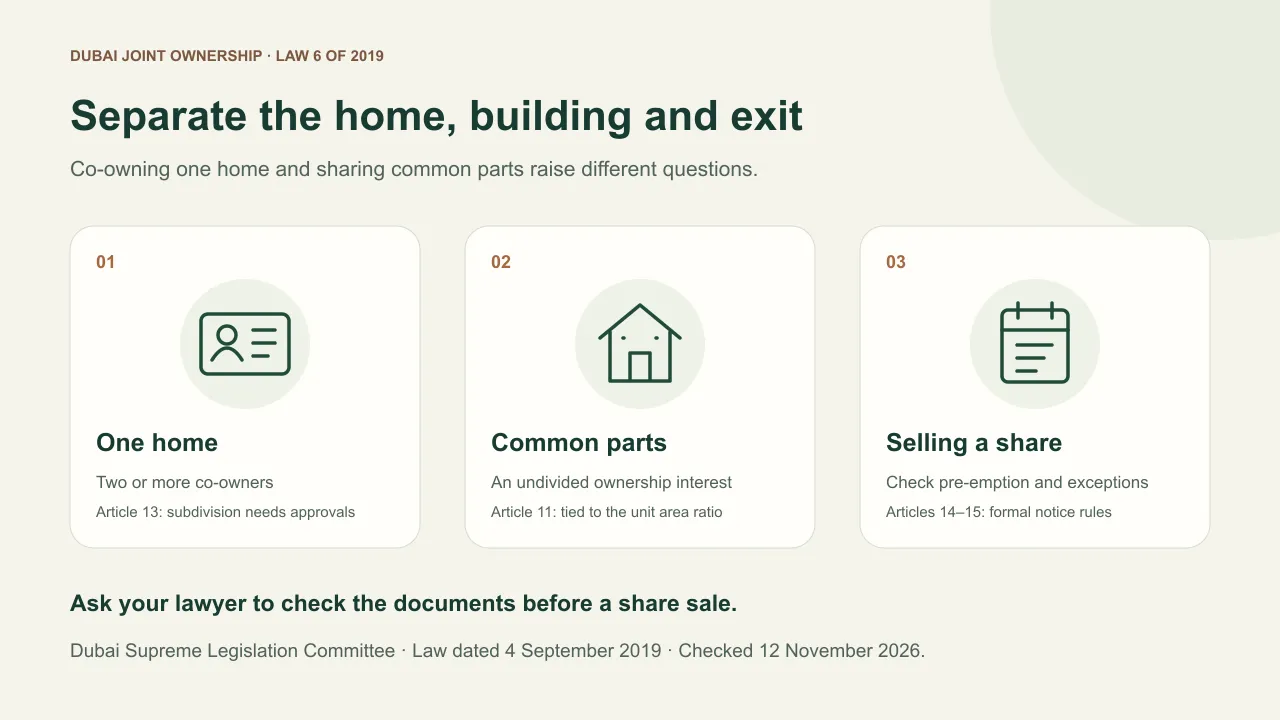
Dubai’s Law No. 6 of 2019 recognises units owned by two or more people. Article 13 restricts physical subdivision: it requires permission under the master community declaration, DLD approval and the necessary authority licences.
An apartment owner also has an undivided interest in the building’s common parts under Article 11. That isn’t the same question as who owns shares of the apartment itself. For building management, read the owners committee guide.
Source · Dubai Supreme Legislation Committee, Law No. 6 of 2019, Articles 11 and 13, issued 4 September 2019; checked 12 November 2026.
Can you buy with a spouse, relative or friend?
DLD’s guidance identifies freehold areas for foreign ownership. Give the trustee the property reference and each proposed buyer’s details, and ask whether they can register the purchase as planned. If you’re borrowing, get the lender’s agreement to the same names and shares before committing.
Take a draft showing each person’s proposed share. Don’t leave the percentage to be settled after the deposit.
Hypothetical example: you agree on 60% and 40%, which total 100%. That describes your proposed ownership split. Ask separately how you’ll divide the deposit, mortgage payments, repairs and sale proceeds; those questions belong in your written agreement.
Source · Dubai Land Department, ownership FAQ, undated; checked 12 November 2026. The example and preparation questions are editorial suggestions.
What should you agree before paying?
Agree who pays, who can make decisions and how either of you can leave. Ask a property lawyer to put those answers into the purchase documents. Keep the sale and purchase agreement checklist beside you.
| Put in writing | A question to settle together |
|---|---|
| Ownership | Who will be registered, and with what share? |
| Contributions | Who pays the deposit, instalments, charges and repairs? |
| Occupation and rent | Who can live there, approve a tenant or receive rent? |
| Decisions | Who can agree work, borrowing, a lease or a sale? |
| Missed payments | What happens if someone cannot contribute? |
| Exit | How is a share valued, who can buy it, and how are disagreements handled? |
| Death or incapacity | Which arrangements and authority documents need separate legal advice? |
For the annual budget, get the actual service-charge records. Ask your lawyer to check your bill-sharing agreement against what each of you owes under the property and finance documents.
Watch out: paying part of the purchase price doesn’t replace checking the ownership record. Keep payment receipts, but ask the trustee to confirm the registered position too.
How do you check the ownership documents?
- Get the property reference. Match the home, seller and proposed buyers across the draft contract and registration papers.
- Open DLD Verify Title Deed for a completed home. The form distinguishes property validation from owner-and-property validation. Have the deed number, year, property type and relevant owner details ready.
- Ask about every proposed owner and share. A general property result doesn’t answer all your registration questions.
- For an off-plan purchase, ask which registration record applies. Use the Oqood guide with the developer’s draft documents.
If names, shares or property references differ, ask the developer or trustee for corrected documents before proceeding. Keep private IDs and ownership papers out of public chats.
Source · Dubai Land Department, Verify Title Deed, undated; checked 12 November 2026. Steps are our preparation checklist.
For an apartment example, the Lamtara 1 document checklist helps you match the building, unit and annual account before discussing shared costs.
Can one co-owner sell their share?
Articles 14–15 give a co-owner a pre-emption right when another owner offers their share to an outsider, subject to stated family exceptions. Ask your lawyer whether those provisions apply before agreeing a share sale.
Article 15 describes a notarial notice setting out the buyer and sale terms. It gives co-owners 30 days from receipt to agree to those terms. An accepting co-owner must notify through a notary within that period, then complete with DLD within 10 working days after it expires.
If you receive a notice, send it to your lawyer with the date you received it. Ask which deadline applies and what must be done through the notary.
Source · Dubai Supreme Legislation Committee, Law No. 6 of 2019, Articles 14–15, 4 September 2019; checked 12 November 2026.
What happens if a co-owner dies?
Ask your lawyer what happens to each owner’s share on death. DLD’s inheritance-registration service requires judicial inheritance documents endorsed by UAE courts. Don’t assume the surviving co-owner simply receives the other share.
Take the ownership papers, proposed will and any finance documents to the adviser together. The inheritance-planning guide explains the questions to prepare.
Source · Dubai Land Department, inheritance registration, undated; checked 12 November 2026.
FAQ
Does a 50% share give you half the rooms?
Don’t assume it does. Article 13 sets conditions for physically subdividing a jointly owned unit. Agree occupation arrangements separately and ask your lawyer what the property documents permit.
Is there one fee for adding a co-owner?
Get a written quote from DLD or the trustee for the actual transaction. A purchase, gift or inheritance needs its own assessment. No universal fee for adding a name is confirmed here.
What should you send your lawyer first?
Send the draft contract, ownership or off-plan registration papers, proposed percentages and a short note on contributions and exit terms. Ask them to resolve differences before you sign.
Sources
- Dubai Supreme Legislation Committee — Law No. 6 of 2019 — dlp.dubai.gov.ae · checked
Issued 4 September 2019. Articles 11 and 13 distinguish common-part interests and co-owned units. Articles 14–15 cover pre-emption, family exceptions, notarial notice, 30 days and subsequent DLD completion within 10 working days. This is a reading aid, not an assessment of a particular transaction.
- Dubai Land Department — Frequently Asked Questions — dubailand.gov.ae · checked
Undated service guidance identifies an owner through registration and distinguishes foreign ownership in freehold areas. Does not confirm any named buyer’s eligibility or proposed ownership percentages.
- Dubai Land Department — Verify Title Deed — dubailand.gov.ae · checked
Undated service form offers Validate Property and Validate Owner and Property, using deed number, year, property type and owner details. No private ownership record searched.
- Dubai Land Department — Real Estate Inheritance Registration — backoffice.dubailand.gov.ae · checked
Undated service card requires judicial inheritance documentation endorsed by UAE courts. Will, gift and exit-from-inheritance cases follow the applicable transaction requirements. No individual succession outcome assessed.
Next stepDue diligence →
More in Due diligence
Start here: Due diligence
- Common real estate terms in Dubai: a buyer’s guide
- Al Safat Dubai green regulations: 2026 buyer guide
- Commercial transactions law in UAE: 2026 buyer guide
- Dubai Land Department: services, fees and buyer checks
- Freehold areas in Dubai: where foreigners can buy in 2026
- Getting an escrow account in Dubai: requirements in 2026
- Property exchange in Dubai: eligibility, steps and fees
- Tourism and Dubai real estate: what to check in 2026
- Escrow account transfer in Dubai: how to apply in 2026
- COVID impact on Dubai real estate: what the data says
- Real estate scams in Dubai: checks before paying (2026)
- Smart contracts for Dubai property sales explained (2026)
- MOU in Dubai real estate: what to check before signing
- Oqood Dubai: registration, fees and buyer checks
- Easement disputes and property ownership in Dubai
- Freezone vs freehold property in Dubai: what to check
- Government schemes for home buyers in the UAE: 2026
- Land grant registration in Dubai: documents and steps
- Property valuation certificate Dubai: how to apply
- Leasehold ownership Dubai: term, rights and costs (2026)
- MOU vs sales agreement Dubai: what are you signing?
- Title transfer Dubai: documents, fees and application
- Dubai real estate escrow requirements in 2026
- A2A form Dubai — what to check before signing
- Anti-trust law Dubai: UAE competition rules for investors
- BUA meaning in real estate: check your Dubai floor plan
- Al Sa’fat Dubai green building system: what to check
- No objection certificate Dubai: property NOC guide
- Property valuation certificate Dubai: check and use it
- How to sell property in Dubai without an agent
- Sharia law in Dubai for property: inheritance in 2026
- Land demarcation in Dubai: steps, documents and fees
- Musataha agreement Dubai: rights, term and document checks
- RVS Dubai: real estate complaints and tracking (2026)
- Property purchase agreement Dubai: SPA buyer guide
- Waiver registration in Ras Al Khaimah: documents and fees