Musataha agreement Dubai: rights, term and document checks
Understand a Dubai Musataha agreement, the scope of the 2022 commercial-land decree, DLD registration and the questions to ask before signing.
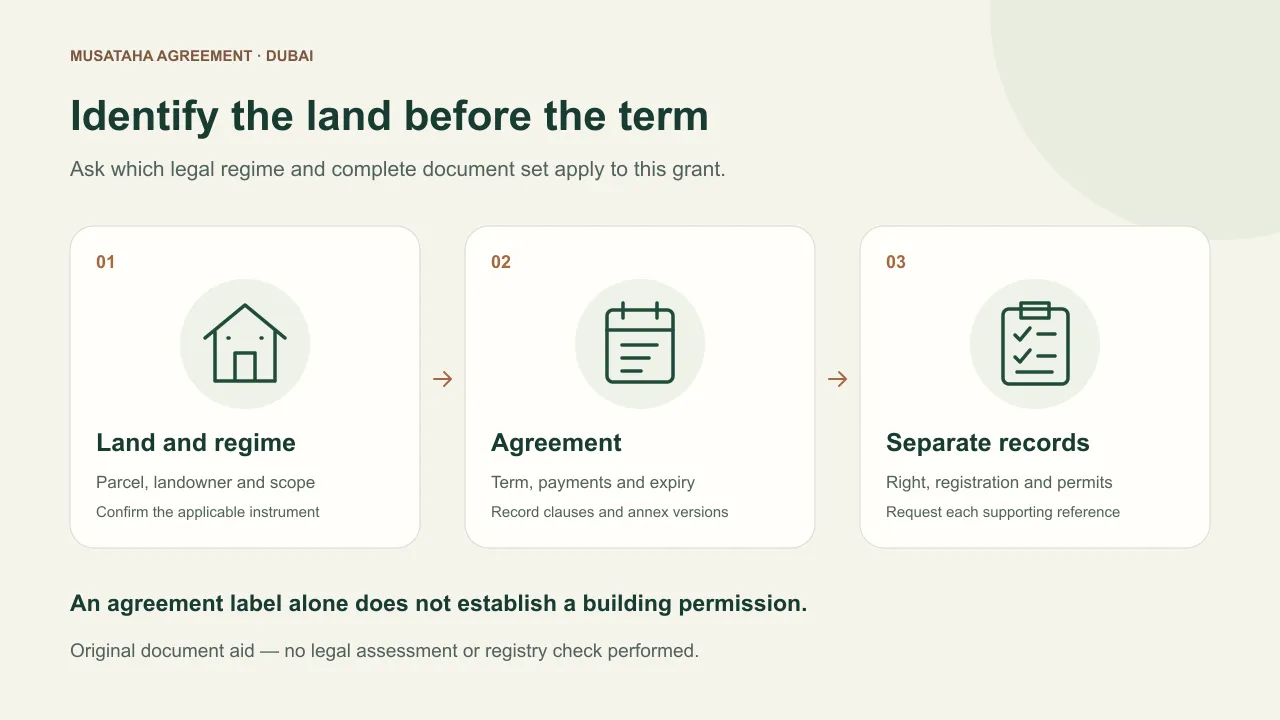
A Musataha agreement in Dubai concerns a right to build on land and benefit from the building for an agreed term; it should not be treated as an ordinary apartment purchase. DLD describes that purpose in its Musataha registration service (checked 9 November 2026). Before signing, identify the landowner, the applicable legal regime, the registered right and the agreement's end-of-term provisions; a document title alone cannot answer those questions.

Musataha, usufruct and buying property: what should you compare?
DLD's registration description distinguishes benefiting from another person's property under usufruct from building on land and benefiting from the building under Musataha (checked 9 November 2026). Use that distinction to identify the transaction being offered, then ask for its supporting records.
| If the offer says… | Ask to see… | Question to resolve |
|---|---|---|
| Musataha | Land identity, proposed agreement and registration particulars | Which right is granted, to whom and for what period? |
| Usufruct | Instrument describing the use and benefit | Does the proposed work fit the actual right and approvals? |
| Purchase of a unit | Sale agreement and relevant property registration | What is being sold and what rights support that unit? |
This is our reading framework, not a legal classification test. If you were expecting an off-plan purchase, use the separate sale and purchase agreement guide. If an agent also presents an A2A cooperation document, keep it separate from the land agreement.
For a home offered on a long lease, the leasehold ownership guide explains how to compare the registered right, expiry date and costs.
Is a Musataha agreement always for 50 years?
Do not assume that from the service label. DLD's service description mentions a Musataha term of up to 50 years. A more specific published instrument, Decree No. (23) of 2022, issued 7 July 2022, concerns commercial or industrial land owned by government, government entities or government-owned/part-owned companies under Articles 1–2. Article 6 specifies up to 35 years, extendable with the owner's approval to 50 years in total. Sources · Checked 9 November 2026.
Under that decree, Articles 5–6 require registration and a specified term. Article 11 links building ownership to the right's period and purpose; absent a different agreement, buildings pass to the landowner when the right lapses. These are scoped provisions of the published decree. Ask a qualified adviser to check current amendments and whether the decree applies to your land. Its English translation states that Arabic prevails.
Ask your adviser: “Who owns this parcel, which instrument governs this grant today, when does its term start, and which renewal or expiry provisions apply?” Record the answer with the actual contract and registry reference. Do not turn a general service-page number into a contractual promise.
A practical Musataha agreement checklist
For each row, record the clause or schedule and what still needs explanation. These are editorial questions, not a statutory list of required clauses.
| Topic | Locate in the file | Ask before signing |
|---|---|---|
| Parties and land | Legal names, capacity, parcel and plan references | Who grants the right, and do all attachments identify the same land? |
| Intended use and works | Use description, drawings and referenced approvals | Which works are proposed and which permissions are already documented? |
| Term | Start, expiry and any extension provisions | What event starts the period, and what needs separate approval? |
| Payments | Consideration, periodic payments, fees and adjustment clauses | What is payable, when, to whom and on which stated basis? |
| Construction responsibilities | Programme, milestones and completion references | Who obtains each permission and records completion? |
| Assignment and financing | Transfer, lender and consent clauses | Which actions need whose consent and registry action? |
| End of term or early termination | Buildings, handback, compensation and outstanding payments | What happens in each scenario, and where is that written? |
| Versions and dispute terms | Annex list, amendments and governing provisions | Which complete signed set should everyone retain? |
If area affects a price or obligation, use the BUA and area comparison guide to record the named measure and units. For the wider purchase file, keep a separate off-plan due-diligence checklist.
Fictional document example: a draft refers to “Schedule A” for the parcel, while a payment annex refers to “Plot B”. Record both page references and request a reconciled signed set. That observation establishes a question, not a finding that the agreement is invalid or that either parcel is correct.
DLD registration: route, documents and fees
The DLD Musataha service card lists registration trustee centres. Its individual-document list includes developer e-NOC in freehold areas, seller identification and a legal POA if represented; it directs unregistered companies to company registration. The published workflow is document review, entry/audit, payment and emailed outputs. Checked 9 November 2026; confirm the list against your actual transaction.
The card's Musataha registration line says 1%, without identifying the valuation base in that line. Resale has separate land/built-up-land wording, and certificate, map and service-partner charges are additional headings. We cannot turn that into a reliable total for your contract. Ask the trustee for the procedure, percentage base, assessed value, other charges and VAT in an itemised quote. No fee calculator here assumes that 1% means 1% of annual rent or of the land purchase price.
Does the agreement mean construction is approved?
For the separate question of locating the parcel's corners, use the land-demarcation authority, stage and document checklist. Ask which output the construction authority needs rather than treating the land agreement as a field survey.
Treat the agreement, registered right and works approvals as separate evidence. Ask which authority has approved which plan and retain the exact reference; the word Musataha alone does not identify a permit for your proposed building. The worksheet below only compares document locations and prepares questions. It cannot verify permissions, ownership, registration or enforceability.
If the papers disagree, save the complete versions and list the differences without editing the signed originals. Ask DLD or the registration trustee about the registry procedure and a qualified adviser about the agreement's effect before committing funds.
If development rights are part of a business acquisition or wider commercial arrangement, keep a separate UAE competition review file. Identifying a property right does not resolve the business-transaction assessment.
If your paperwork records an approved land grant rather than a right to build on another party’s land, use the separate land-grant registration guide. Ask DLD which instrument and registration service apply before using a Musataha fee or procedure.
FAQ
Is Musataha the same as owning the land?
Do not infer land ownership from a grant of Musataha. Identify the landowner and the precise registered right; for the scoped 2022 decree, building ownership is linked to the right's term and purpose.
Can I automatically renew for another 50 years?
No automatic extension is established here. The published 2022 decree's Article 6 specifies owner approval and a total limit within its scope; check the applicable regime and your actual contract.
Is the registration fee simply 1% of my quoted price?
The checked service-card line does not state that valuation base. Ask for the transaction-specific base and full fee schedule rather than substituting your own assumption.
Can the comparison tool approve my agreement?
No. It records document references and questions only. It does not determine which version governs or verify a right, permission or legal outcome.
For access across a neighbouring plot, put the recorded right beside the plan using the easement dispute checklist.
Sources
- Dubai Land Department — Usufruct/Musataha right registration application — dubailand.gov.ae · checked
Service description distinguishes building on land from using another property; registration channel, documents and fee headings checked. The 1% registration line does not specify its valuation base. No case-specific quote or registration tested.
- Dubai Supreme Legislation Committee — Decree No. (23) of 2022 — dlp.dubai.gov.ae · checked
Issued 7 July 2022. Articles 1–2 define government-linked commercial land scope; Articles 5–6 registration and term, Article 11 building ownership. Published English text, with Arabic prevailing; not a complete current federal/Dubai amendment-chain review or an applicability finding for private land.
Compare your Musataha documents. Prepare clearer questions.
Put two document versions or an agreement and its schedule side by side. Keep clause references and questions together before speaking with your adviser.
- Use and benefitDLD describes usufruct in terms of using and benefiting from another person’s property.
- Build and benefitDLD describes Musataha in terms of building on land and benefiting from the building.
These are service descriptions, not a classification of your agreement or building permission.
Does the word Musataha mean my proposed works are approved?
No approval can be established from that label alone. The retained DLD service description distinguishes using and benefiting from another person’s property from building on land and benefiting from the building. It does not classify your agreement or grant building permission. Read the dated source basis ↓
Fictional document-reading examples
- An agreement names Musataha. Record the clause reference under Rights, works and proposed use. Ask which record identifies the right being registered; do not treat the name as approval of a particular design.
- A plan describes proposed works. Record its revision and the agreement’s plan reference under Plot and attached plan. Ask whether these are the matching versions and which permissions need separate confirmation; the plan description alone does not answer those questions.
A question to adapt for your adviser
Which record identifies the right being registered, and which separate records should we check for the proposed works and use? Please point me to the relevant agreement clause, matching plan revision and permissions that need confirmation.
This is our original document-reading question, not an official form or a prescribed document list. It does not confirm approval, eligibility or which permissions apply. Keep actual documents and personal details outside this page.
Dubai Land Department · Usufruct / Musataha right registration service description · Source checked 25 October 2026 (retained extraction; cache age unknown). Explanation added 29 October 2026, not a fresh legal or permission check.
Record the clause and plan references in the worksheet ↓Two documents. Traceable questions.
Our original organising prompts are not prescribed agreement clauses or a legal completeness checklist. Open your documents beside this page. Use short, non-personal labels and clause references only — no names, actual plot numbers, IDs, bank details or contract passages.
No upload · no storage · no account. Entries stay in this tab and disappear on reload. Selecting or printing shares nothing automatically.
Your adviser questions
Interactive question sheet not loaded.
Illustrative comparison — not a real agreement
Draft A clause 4 describes the works; Schedule B page 2 uses different wording. Record both locators and ask: “How do these descriptions fit together, and which version should accompany this draft?” This does not decide which document governs.
Source and limits
DLD describes two different purposes
DLD describes usufruct as using and benefiting from another person’s property, and Musataha as building on land and benefiting from the building. This service description does not classify your agreement or grant building permission.
DLD registration-service description ↗ · retrieved 2026-10-25. This source supports the short purpose distinction, not our comparison prompts or a consolidated legal review.
Your observations, not legal conclusions
References and questions are entered by you. A literal difference does not decide which document governs. No entry is checked against a registry or statute.
Current consolidated law is not verified
The operative federal and Dubai instruments and amendment chain were not verified in this review. No duration, renewal, ownership, fee, enforceability or agreement-approval conclusion is supplied. Ask a qualified UAE legal adviser to interpret your documents and the applicable law.
Is this an agreement template or legal review?
No. These are our original organising prompts, not prescribed clauses or a completeness checklist. The result is a question sheet, not an agreement, legal opinion or registration application.
For the applicable registration process, confirm the current service with DLD or a registration trustee. Registration records, contract meaning and building permissions answer different questions.
Comparing an off-plan sale agreement instead? Use the separate SPA worksheet →
Next stepDue diligence →
More in Due diligence
Start here: Due diligence
- Common real estate terms in Dubai: a buyer’s guide
- Joint ownership Dubai real estate: a 2026 buyer guide
- Al Safat Dubai green regulations: 2026 buyer guide
- Commercial transactions law in UAE: 2026 buyer guide
- Dubai Land Department: services, fees and buyer checks
- Freehold areas in Dubai: where foreigners can buy in 2026
- Getting an escrow account in Dubai: requirements in 2026
- Property exchange in Dubai: eligibility, steps and fees
- Tourism and Dubai real estate: what to check in 2026
- Escrow account transfer in Dubai: how to apply in 2026
- COVID impact on Dubai real estate: what the data says
- Real estate scams in Dubai: checks before paying (2026)
- Smart contracts for Dubai property sales explained (2026)
- MOU in Dubai real estate: what to check before signing
- Oqood Dubai: registration, fees and buyer checks
- Easement disputes and property ownership in Dubai
- Freezone vs freehold property in Dubai: what to check
- Government schemes for home buyers in the UAE: 2026
- Land grant registration in Dubai: documents and steps
- Property valuation certificate Dubai: how to apply
- Leasehold ownership Dubai: term, rights and costs (2026)
- MOU vs sales agreement Dubai: what are you signing?
- Title transfer Dubai: documents, fees and application
- Dubai real estate escrow requirements in 2026
- A2A form Dubai — what to check before signing
- Anti-trust law Dubai: UAE competition rules for investors
- BUA meaning in real estate: check your Dubai floor plan
- Al Sa’fat Dubai green building system: what to check
- No objection certificate Dubai: property NOC guide
- Property valuation certificate Dubai: check and use it
- How to sell property in Dubai without an agent
- Sharia law in Dubai for property: inheritance in 2026
- Land demarcation in Dubai: steps, documents and fees
- RVS Dubai: real estate complaints and tracking (2026)
- Property purchase agreement Dubai: SPA buyer guide
- Waiver registration in Ras Al Khaimah: documents and fees